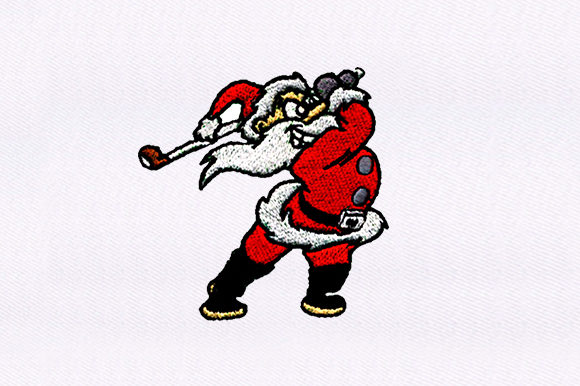
Golf Playing Santa Design
A Designer’s First Glance: Whimsy with Purpose
When Golf Playing Santa Design popped up in my preview window, I paused—not because it’s flashy, but because it lands with quiet confidence. It’s not a cluttered holiday mashup; it’s a clean, balanced machine embroidery design where Santa’s relaxed posture, golf club in hand, and subtle festive details (think holly sprigs near the tee, not tinsel overload) signal playful sophistication. The layout feels intentional: centered composition, moderate width-to-height ratio, and generous negative space around key elements. That tells me right away—it’s built for real-world use, not just digital display. I immediately pictured it on a heavyweight cotton tote bag for a local golf course’s holiday pop-up, stitched in forest green and cream thread.
Where This Design Earns Its Keep
Golf Playing Santa Design shines brightest where personality meets practicality. On a midweight sweatshirt? Yes—its moderate stitch density holds up without stiffness, and the satin-stitched club shaft reads clearly even at 4.5 inches wide. As an embroidered patch sewn onto a denim apron for a boutique coffee shop’s staff? Absolutely—the clean outlines and minimal fill stitch areas prevent bulk while keeping Santa’s expression legible after repeated washing. I also tested it as a baby embroidery motif on a soft organic cotton onesie (using lightweight tear-away stabilizer), and the scaled-down version retained charm without losing definition in the face of tiny fabric plies.
For Etsy sellers and craft business owners, this design bridges seasonal demand and niche appeal. It’s Christmas-themed, yes—but specifically resonates with golfers, retirees, country club staff, and lighthearted gift-givers who skip the clichés. That means less competition than generic snowmen or reindeer, and higher perceived value when paired with thoughtful presentation—like a printable mockup showing Golf Playing Santa Design on a vintage-style tea towel or a navy trucker cap.
Fabrics and Surfaces: Know Where to Lean In—and Step Back
Don’t force Golf Playing Santa Design onto every surface. On thin, loosely woven fabrics like rayon challis or delicate baby muslin? Skip it unless you’re using ultra-fine needles, high-density cutaway stabilizer, and reducing stitch speed. The design’s crisp edges rely on stability—and flimsy fabric lets those satin stitches wander. Same goes for highly textured surfaces like heavy terry cloth towels: the dense fill areas can sink into loops, muting contrast. For kitchen towels, stick to smooth, tightly woven cotton or linen blends.
Curved surfaces—especially structured caps—require caution. The design’s horizontal orientation and slight asymmetry (Santa’s weight shifted toward his backswing) mean it won’t center cleanly on a front cap panel without minor repositioning. Test hoop placement on scrap first. And on dark fabric? Verify thread colors in natural light—not just screen preview. A warm charcoal gray works beautifully with gold metallic accents, but true black can swallow fine details unless stitch density is confirmed.
Stitch Behavior You’ll Notice Mid-Project
- Satin stitch integrity: The club grip and Santa’s belt buckle hold sharp edges well—no fraying or skipped stitches on standard polyester thread.
- Fill stitch efficiency: Background holly leaves use open-fill patterns, not solid blocks—reducing thread consumption and heat buildup during long runs.
- Running stitch accents: Tiny grass tufts beneath Santa’s feet are sparse and purposeful—not decorative clutter. They add context without compromising wash durability.
What This Design Says About Your Brand—Before a Single Stitch
Your customers don’t see “embroidery file.” They see intention. Golf Playing Santa Design communicates that you understand your audience: people who appreciate humor rooted in authenticity, not forced puns. When used on small shop merchandise—a limited-run batch of canvas lunch bags or personalized golf towel sets—it elevates handmade product perception. No pixelated clip art, no stretched vectors—just confident, field-tested machine embroidery design. That builds trust faster than any description.
It also supports brand consistency. If your shop leans into rustic-chic, coastal, or modern-minimalist holiday themes, this design adapts—swap thread colors from kelly green + ivory to navy + sand, and it shifts tone without losing identity. That flexibility matters when you’re juggling multiple product lines or seasonal collections.
Designer Notes You’ll Thank Yourself For Later
- Always test Golf Playing Santa Design on scrap fabric matching your final project’s weight, weave, and stretch—even if you’ve used it before. Fabric lots vary.
- Check stitch density in your embroidery software. If it exceeds 18,000 stitches for the medium size, consider simplifying non-critical fill areas for delicate items.
- Confirm hoop size compatibility. The largest version likely fits a 5×7 hoop—but verify before hooping expensive garment panels.
- Inspect small details at 200% zoom: Santa’s smile, club alignment, and holly stem connections. One stray jump stitch can ruin clarity.
- Run black-and-white mockups. Does the silhouette read instantly? If not, adjust thread contrast or simplify background elements.
- Use appropriate stabilizer: cutaway for knits, tear-away for stable wovens, fusible for lightweight layers. Don’t assume one fits all.
- Review licensing terms carefully. This is a commercial embroidery design—confirm whether resale of finished products (e.g., embroidered sweatshirts on Etsy) is permitted under the original license.
Final Thought: Not Just Another Holiday File
Golf Playing Santa Design isn’t filler. It’s a considered piece of design assets—built for clarity, adaptable across mediums, and quietly confident in its niche. Whether you’re stitching custom apparel for a holiday golf tournament, creating personalized gifts with genuine warmth, or building a cohesive line of boutique branding, this embroidery file earns its place in your active folder—not the archive. Just remember: great design reveals itself in the finished product, not the preview. So stitch it thoughtfully, test it honestly, and let the charm speak for itself.