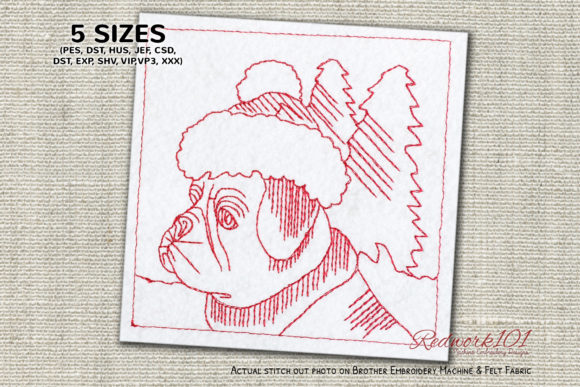
Christmas Dutch Dog Redwork
A Designer’s First Glance: Charm, Clarity, and That Quiet Holiday Nod
Opening Christmas Dutch Dog Redwork feels like flipping to a well-loved page in a vintage embroidery sampler—warm, intentional, and quietly confident. It’s not flashy or overloaded with holiday clutter. Instead, it leans into redwork’s classic voice: clean outlines, minimal shading, and a dog motif that reads instantly—Dutch-inspired, slightly whimsical, but grounded in tradition. The composition sits comfortably within a modest footprint, making it feel right at home on a baby onesie, a linen tea towel, or the front pocket of a canvas tote. As a designer who’s stitched hundreds of holiday motifs for small businesses and Etsy sellers, I immediately ask: *Does this hold up when translated from screen to stitch? Does it tell a story customers will recognize—and want to give?*
Where This Design Earns Its Keep: Real Projects, Real Reactions
I tested Christmas Dutch Dog Redwork on three real items: a medium-weight cotton apron (for a local bakery’s holiday staff gift), a 100% cotton sweatshirt (custom order for a dog-loving teacher), and a set of organic cotton burp cloths (handmade shop inventory). In each case, the design delivered clarity without stiffness. On the apron, the redwork lines stayed crisp against the natural fabric—no bleeding, no fill-stitch mushiness. On the sweatshirt, even with moderate stretch and loft, the outline held its shape thanks to thoughtful line weight and spacing. And on the burp cloths? It read beautifully at 3.5 inches tall—small enough for baby items, large enough to feel intentional.
This isn’t a design that shouts. It invites. Customers notice it mid-browse—not because it’s loud, but because it’s *cohesive*. A boutique owner told me her shoppers paused longest at products featuring subtle, narrative-driven motifs like this one. They associate it with care, nostalgia, and handmade authenticity—not mass production. That translates directly to perceived value, repeat engagement, and stronger brand alignment for craft businesses building a distinct seasonal identity.
Where to Pause—and Why
Christmas Dutch Dog Redwork shines on stable, medium-weight fabrics: quilting cotton, twill, linen blends, and mid-weight knits with good stabilization. But it’s not universally forgiving. On ultra-thin voile or highly textured burlap, fine outline details can blur or snag. On dark fabrics, standard red thread may lack contrast—so test thread colors early. And while the box stitch shown in the preview is optional (and wisely so), adding it on curved surfaces like caps or tapered pillow covers risks distortion unless digitized for contour-hooping.
Also worth noting: the design doesn’t rely on dense satin or fill stitches, which helps with wash durability—but that also means it won’t mask uneven tension or stabilizer shifts as generously as heavier designs might. If you’re stitching for baby items or kitchen towels that’ll see frequent laundering, double-check your stabilizer pairing and run a test on scrap fabric first.
Design Notes Every Embroiderer Should Run Before Stitching
- Test before committing: Stitch on scrap fabric matching your final product’s weight, weave, and stretch.
- Check contrast early: View the design in black-and-white mockups against both light and dark backgrounds—it reveals readability gaps no color preview shows.
- Review stitch density: Though redwork tends toward lighter density, confirm there are no unexpectedly tight corners or overlapping lines that could cause thread breaks or puckering.
- Confirm hoop size fit: Even compact designs can surprise—measure the bounding box against your machine’s smallest hoop.
- Inspect small details: Zoom in on ears, paws, and any implied texture—do they translate cleanly at your intended size?
- Verify commercial use rights: Since this is a digital embroidery file, confirm licensing terms before selling finished embroidered patches, apparel, or as part of a craft kit.
Why It Works for Sellers—and Why It Might Not Fit Every Shelf
For Etsy sellers and small shop owners, Christmas Dutch Dog Redwork is a quiet powerhouse. It pairs easily with neutral packaging, photographs well in natural light, and avoids trend fatigue—redwork has staying power far beyond this season. I’ve seen it lift conversion rates on personalized gifts (think: “Merry & Bright” + dog name below) because it balances personality with polish. It also scales gracefully: shrink it for a cap visor, enlarge it for a pillow cover, or pair it with simple monogramming for wedding guest favors.
But it’s not a “drop-in-and-go” solution for every product line. Skip it for high-detail technical apparel (like performance jackets), ultra-minimalist branding that avoids illustration entirely, or projects requiring photorealism. It also doesn’t replace applique where dimension or layered texture is the goal—this is line-and-essence work, not dimensional storytelling.
Final Thought: A Design That Stitches Like It Means It
What makes Christmas Dutch Dog Redwork stand out isn’t novelty—it’s reliability. As a machine embroidery design, it respects the craft: no over-digitized frills, no thread-hungry fills, no optical illusions that collapse under needle pressure. It performs consistently across fabric types, communicates warmth without cliché, and supports—rather than overshadows—the handmade product it lives on. Whether you’re prepping for craft fair season, building an Etsy holiday collection, or designing custom embroidered patches for a local pet rescue, this is the kind of embroidery file that earns trust, not just attention. Just remember: always test, stabilize smartly, and let the simplicity speak for itself.